• Skip to main content
  • Skip to footer

Havelock London

Modern Value Investing

  • About
  • News
  • Contact us
  • Fund
  • Investment Approach

Matthew Beddall

July 11, 2024 By Matthew Beddall

Where do we go from here?

Our modus operandi is to be bottom-up investors, studying companies that we think might make for overlooked bargains. This, however, doesn’t entirely free us from thinking about the bigger picture both within markets and the world at large. As we zoom out from “micro” to “macro”, we have to make do with abstractions as the complexity of the real world otherwise becomes overwhelming.

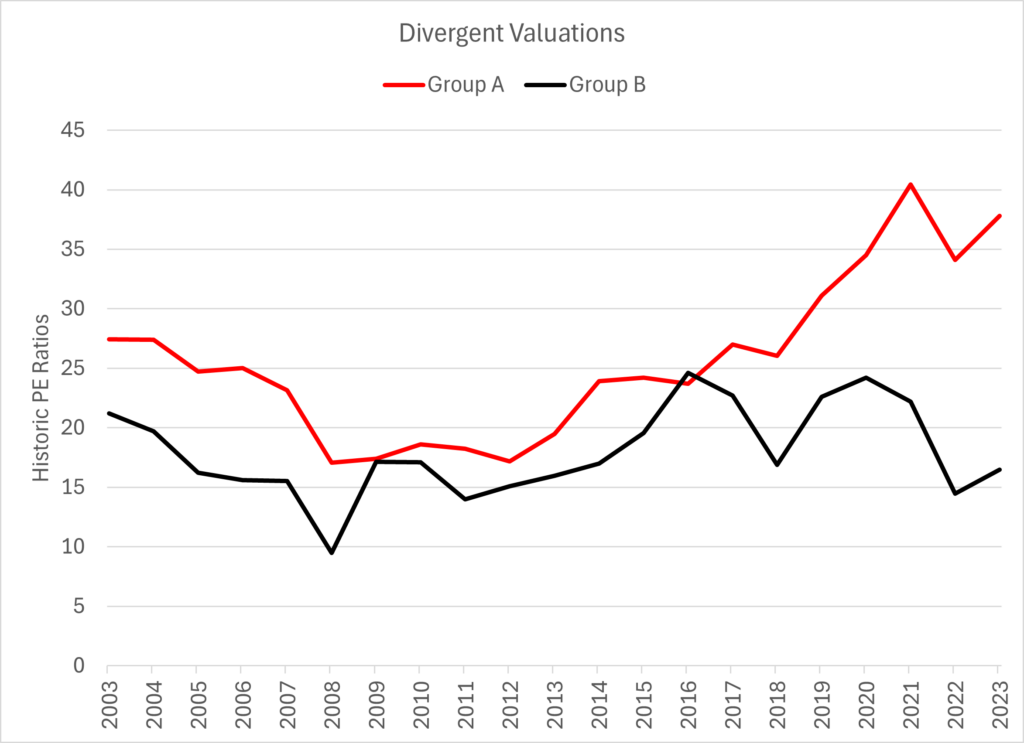
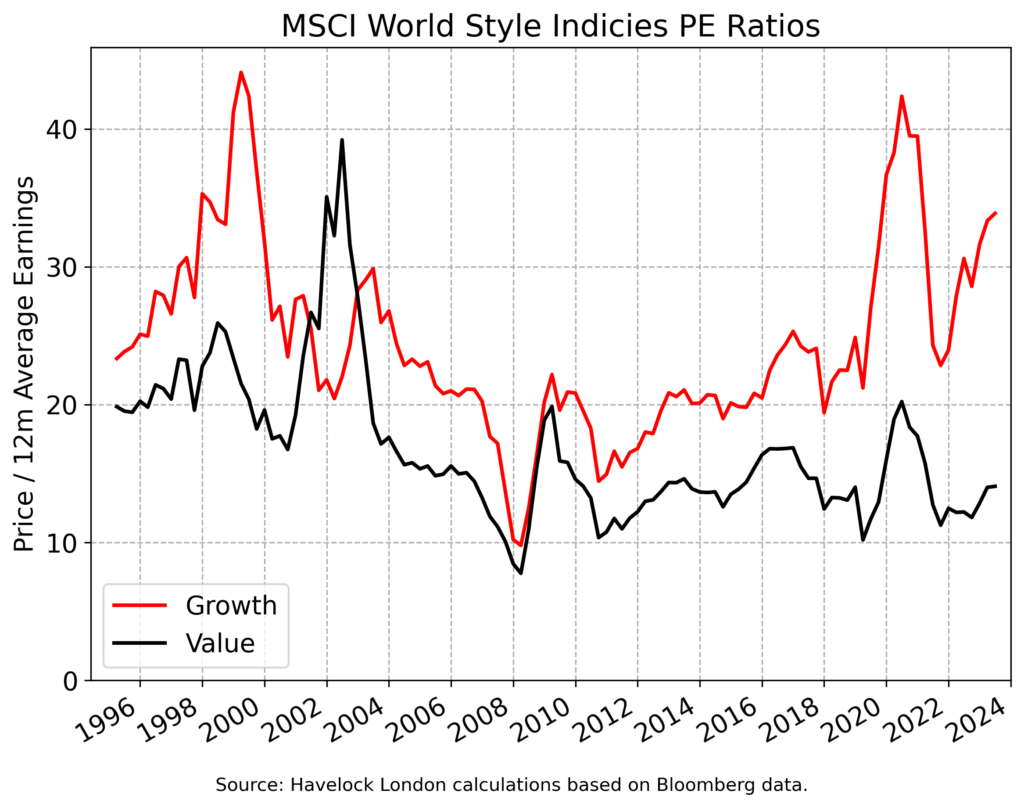
One such abstraction is “value” versus “growth”. Although it seems absurd to categorize 1000s of companies as either displaying one characteristic, or the other, it is a simple and convenient approximation of two different investment approaches. I, like many other value investors, have been quick to highlight the increasing premium that investors have paid to own “growth”. This is shown below by the price earnings ratios of the MSCI World Growth and Value indices.

The chart shows that investors have been willing to pay an increasingly high multiple of earnings for the growth index in the last fifteen years. This “multiple expansion” has created a performance tail wind for growth investors, that has left many companies looking expensive relative to history.

The big question is what does this mean for prospective future returns? Does “growth” face a prolonged period of underperformance versus “value”?

I see three possible explanations for the current high premium being paid for growth, each of which would lead to a different conclusion about the future:

  • There is a rational reason why investors are paying such a high premium.
  • Investors aren’t paying a high premium, because price earnings ratios misstate it.
  • The high premium is irrational.

Prior to 2022 “conventional wisdom” suggested the elevated premium for growth stocks was rational, because interest rates were so low. For the benefit of readers who live in a cave, the argument was that earnings in the distant future had become more valuable in terms of “today’s money”, implying a “bird in the hand” was worth “one in the bush” and not “two”.

Given today’s higher rates, the interest rate justification for this premium isn’t credible. Could it be that the premium has increased this year because markets are “discounting” interest rates falling back to previous levels? Given that the growth index price earnings ratio is higher than at most times when rates actually were close to zero, this argument seems like a stretch.

There have been, and will be, other rationalisations for the premium. For example, that Generative AI will unleash a new wave of earnings growth for a select group of companies. I haven’t seen an explanation that I find credible, but it doesn’t mean that one doesn’t exist.

The second possibility is that an analysis based on price earnings ratios is misstating the premium. This argument holds more sway with me, as “earnings” are a complex and somewhat artificial construct. For example, many highly valued companies derive their earnings from intangible assets, and it can be argued[1] that accounting rules tend to understate profitability in this instance.  Similarly, a recent paper[2] used a measure termed “economic profits” to show a small group of large companies making an outsized contribution, but did not venture onto what valuation investors should pay to own them.

Given that the growth index is also at an historically high premium based on price-to-cashflow and enterprise-value-to-EBITDA ratios, I am sceptical of “new paradigm” type explanations. I do however accept that price-earnings ratios, or the style indices themselves, might be misrepresenting the size of the premium that investors are paying for growth companies.

The third explanation is that the high premium is irrational, and that it represents a “bubble”. Clearly, we all rationalise things differently, and so perhaps what is irrational to me isn’t to others?

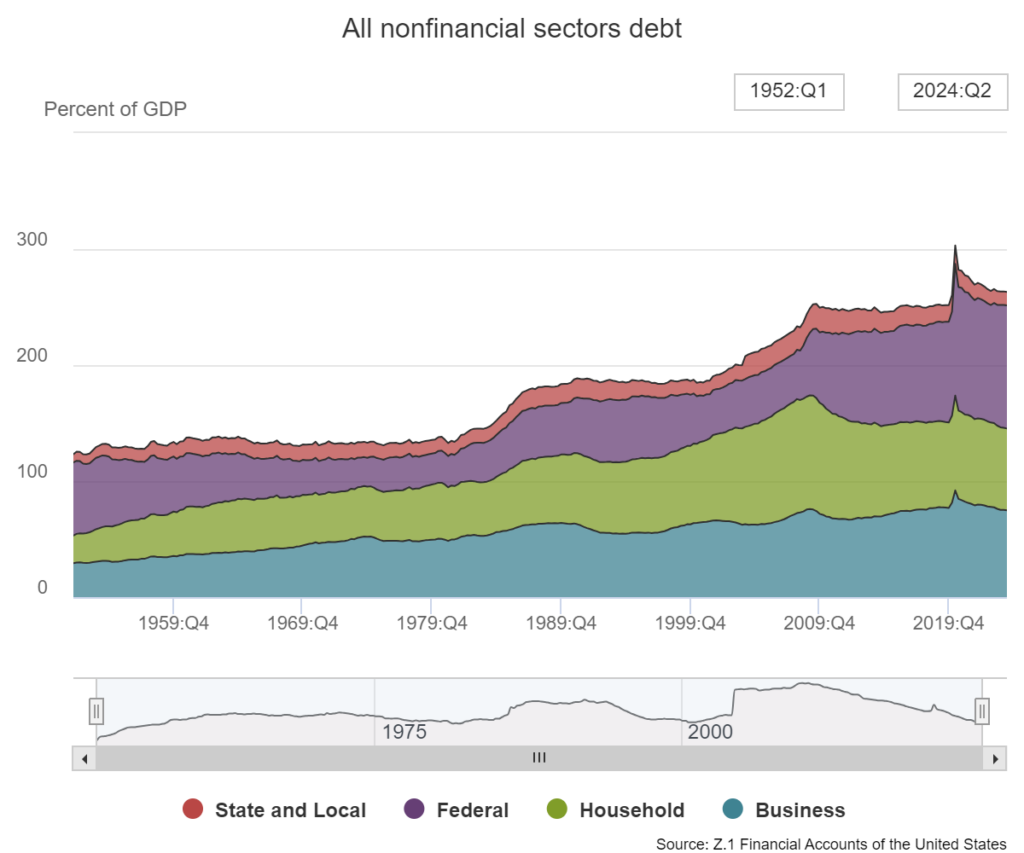
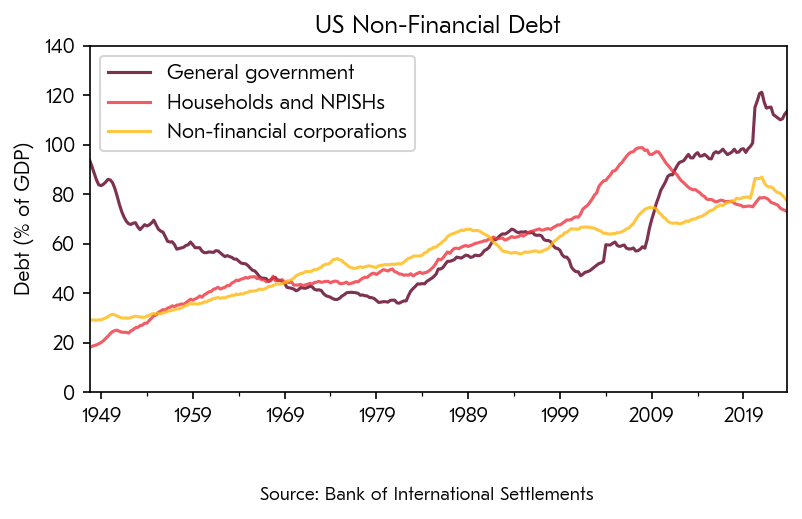
My preferred explanation is that the high premium is the product of governments and central banks underwriting risk in markets. Again, for the benefit of cave dwelling readers, the 2008 crisis was handled by “pumping” liquidity into the financial system, with central banks using newly created money to purchase financial assets. The majority of these assets were government bonds, and so the net effect was both to raise asset prices and put money into government coffers. The same approach was repeated during the COVID crisis. The chart below shows US non-financial debts since 1948, broken down between government, households and companies. The chart for the UK looks very similar, but I focus on the US given its dominance in financial markets.

This chart tells multiple stories. It shows the rapid build-up of household debt prior to the 2008 financial crisis, and how the subsequent deleveraging came at the expense of increased government borrowing. It also shows how the shortfall in economic activity during the COVID crisis was funded by a second large increase in government debt.

I believe that the net effect is that most investors have rationalised paying a large premium for the most successful companies, because it appears that central banks will intervene in the event of a large market decline. I do not assume this pattern of “privatised gains” and “socialised losses” must continue, but I can see why others would.

The previous chart also shows how all three categories of borrower have become increasingly indebted over the long term, such that total debt levels in the economy are at a post-war high. I believe that this lies behind many of the political challenges that we currently see, but that is a story for another day!

Economist, Hyman Minsky, theorised that long periods of prosperity and investment gains encourage diminished risk perception and a build-up of debt, that will ultimately end with a “Minsky Moment” collapse in asset prices. The build-up of debt in the world’s major economies is without doubt, and I think that the high premium investors are willing to pay to own growth companies is one of many pieces of evidence that suggest a diminished perception of risk.

The different interpretations of the high premium currently being paid for “growth” would lead to different conclusions about the future. If the premium is rational, or non-existent, then there is no reason for concern. If on the other hand it is irrational, investors in the most expensive companies will likely experience future returns are at best disappointing and at worst stomach-churningly awful.

It would be bold to say that you believe any one of these explanations with complete certainty. I prefer to think in terms of probabilities, and I put a higher likelihood on the premium being irrational, but accept that it is also possible that one of the first two explanations is correct. Only if you are very confident that the high premium is justified, should you be “all in” on growth.

Many investors will draw the conclusion that they wish to guard against the risk of a fall in asset prices by owning the highest quality assets, but this ignores the price paid to purchase them. This approach didn’t work in the late 1960s and early 1970s, when investors in blue chip “Nifty Fifty” companies were subject to a subsequent decade of disappointing returns[3].

Returning to where I started, “value” and “growth” are crude abstractions of a complex reality. The high price earnings multiple for the MSCI World Growth index is driven by individual companies, like Nvidia, each of which will have their own narrative. In the same way that not all “growth” stocks will be overvalued, not all “value” stocks are sub-par duds.

I think that it is the combination of the quality of what you own, and the price you pay, that will best guard against loss of capital.  This is the approach that we use, and I believe why we were able to sidestep the large falls in asset prices during 2022.

I do not know what will happen next, but the amount of debt in the world’s major economies puts us in unchartered territory. For this reason, I think it is dangerous to assume that the “status quo” in markets must continue. My best guess is that central banks and governments will sooner, or later, pull back from underwriting the risk of investing, which will place a renewed importance on valuations.

Matthew Beddall

CEO and Fund Manager, Havelock London Ltd


[1] https://www.morganstanley.com/im/publication/insights/articles/article_intangiblesandearnings_us.pdf

[2] https://www.morganstanley.com/im/publication/insights/articles/article_stockmarketconcentration.pdf

[3] https://www.clearfinances.net/nifty-50-bubble/

Filed Under: Commentary

June 24, 2024 By Matthew Beddall

The Voting Machine

The grandfather of value investing, Ben Graham, famously said that “in the short run, the market is a voting machine but in the long run, it is a weighing machine”.

What Graham meant is that in the long-term market prices move to reflect the economic fundamentals of companies, whereas in the short-term they are dictated by the whims of market participants. By “economic fundamentals” I really mean the earnings that a company generates for shareholders, as measured by either the rules of accounting or cashflows. Graham’s opinion that prices move much more than is justified by earnings was validated in the 1990s by the academic Robert Shiller, for which Shiller was later awarded a Nobel Prize.

The chart below shows the relative expensiveness of “growth” versus “value” companies, US versus non-US companies, and large versus mid-size companies[1]. The lines tell us the extent to which investors are currently willing to pay a premium to own the former, over the latter.

This shows that the premium to own growth companies, US listed companies and large cap companies appears to be as high as it has ever been in the last 30 years. As value investors we think this trend is more likely to reverse than continue.

We believe these premiums are the product of the “voting machine”, with the enthusiasm that many investors have for certain companies running well ahead of a reasonable expectation of their ability to generate earnings. The counterargument, based on the “weighing machine”, is that the premium investors are paying is because a select group of companies are likely to grow earnings at a much faster pace than they have done historically.

Our portfolio is not just focused on value companies, but is currently also exposed to non-US listed mid sized companies. This is because it is where we see opportunity. The fund has made money in each of the five calendar years that it has been running, but the trends that I describe mean that its relative performance has faced multiple headwinds. If these trends reverse, the fund stands to benefit, as they should move to become tailwinds to our performance. We cannot know if, or when, this might happen, but we believe history is on our side.

In short, we believe our fund provides exposure to the “weighing” machine, not the “voting” one.

Appendix

The table below outlines the data that was used to produce the chart:

We used price earnings ratios based on 10-year average inflation adjusted earnings, as this removes the “noise” of individual years’ earnings. We also produced charts based on the prior year’s earnings and prior year’s cashflows, which show the same overall trends. These are shown below:


[1] The MSCI World size indices have a limited history, and so the size factor uses just US data prior to 2009.

Filed Under: Commentary

March 14, 2024 By Matthew Beddall

Can trees grow to the sky?

The performance of American public equities since the Global Financial Crisis has been exceptional, with the result that they account for more than 70% of the MSCI World index. This is demonstrated in the chart below, that shows the relative returns of owning American equities versus other developed markets.

The chart also shows that there have been periods of time when the reverse has been true, with the returns from US equities lagging the rest of the developed world during the 1970s and 1980s. This pattern of prolonged periods of under and over performance held for the entire twentieth century[1], despite the long-term trend of US dominance versus “old world” economies.

The technological revolution that we are currently living through has very much been centered in the US, meaning that it has spawned many of the world’s largest and most profitable companies. The outperformance that is shown above tells us nothing about the growth in earnings power in US companies, and the extent to which it has also outpaced the rest of the world.

The MSCI US index currently has a price-to-earnings ratio of 25x, versus the MSCI World index ex US having a ratio of 15x. This tells us that US companies look more expensive than their developed market counterparts, based on their previous year’s earnings. On this basis, the US index has become progressively more expensive in the last decade, which is only rationalised by a growing belief that future earnings have much higher growth yet to come.

The “Magnificent Seven” companies account for 28% of the MSCI US Index, and so have become the focal point for US equities. They have been the driving force of strong earnings growth, strong share price performance and high valuations. The next chart shows the average net profit margin for the group of seven, which is the fraction of their sales left over after they have paid all operating expenses, finance costs, and taxes. On this basis these companies have never had it so good.

The average price earnings ratio for the Magnificent Seven is 37x last year’s earnings, meaning that they appear markedly more expensive than the MSCI US index on 25x earnings. To justify this valuation, they either need to see strong sales growth or increase profit margins[2]. At their current size, growth in relative terms corresponds to large quantities of incremental sales in absolute terms, which is a challenge. Likewise, growing margins from current peak levels will also be a challenge.

I cannot know that the premium investors are currently paying to own US equities, and specifically the Magnificent Seven, will not eventually be justified by higher earnings. What I do know is that because much growth is already “priced in”, there is a substantial risk of disappointment if they fall short. The dominance of these companies means that many portfolios will, like the passive MSCI World index, have a concentrated exposure to this risk.

The next chart shows the price to ten-year average inflation adjusted earnings for the MSCI World and MSCI World ex US indices. This tells us that if long term average earnings were to be a good guide to the future, then US equities currently look very expensive. For the Magnificent 7 this ratio is, on average, 65x, making them look more expensive still.

We do not want to rely on optimism, and are particularly cautious about requiring record-high profit margins to justify an investment. We see plenty of opportunities where only modest expectations for the future are required, for valuations to be attractive. This “glass half empty” approach means that we do not currently own any of the Magnificent Seven, despite the fact that they are attractive businesses. Put simply, we believe a good business only makes for a good investment at the right price.

Source: All data used in charts and commentary is sourced from Bloomberg.

[1] See https://globalfinancialdata.com/the-united-states-or-the-rest-of-the-world

[2] They can also grow earnings by buying back shares, but this is not very value accretive at current valuations.

Filed Under: Commentary

January 22, 2024 By Matthew Beddall

New Year’s Resolutions

If you are anything like me you will have arrived in January willing yourself to be a better person, full of resolutions to eat less, exercise more, and to use your time more wisely. As we all know it is much easier to plan to do this, than to actually do it! At every twist and turn temptation lures you down the alternative path. My personal nemesis is dark chocolate. Put a bar of it within a hundred feet of me and I turn into Augustus Gloop, shoveling it down as if I hadn’t eaten for a week. Now of course I know that my body would be better served by time on the treadmill, but my inner chimp is somehow blind to this in the moment that temptation strikes.

The reason we struggle to stick to our resolutions is that the “good stuff” invariably gives us a dopamine hit that we are evolved to desire. My pre-historic ancestors didn’t have to contend with a Hotel Chocolat outlet on every street corner, and with limited supply it made sense to indulge whenever the opportunity arose.

When you view the world through the lens of dopamine hits, you realise that many highly profitable businesses are built on our inability to suppress desire. Tobacco, alcohol, and sugar are all tangible examples that have spawned lucrative multi-trillion-dollar industries. Some other examples I can think of are perhaps less suited to a family audience!

Human ingenuity, being what it is, has increased the variety of ways that we can get our kicks, and made them more copious. Digital technology took this to another level, with social media platforms being examples of mighty businesses created in the knowledge of what makes our inner chimp tick. Search for a video of a cat, and Google will provide you with 466 million different choices. You could watch them for the rest of your days, without need for repetition.

Before you start thinking that I am subjecting you to a treatise[1] on healthy living, I will return my narrative to investment management.

In much the same way that our personal indulgences stimulate dopamine in our brains, many of the forces acting on us as professional investors do too. We are subject to a virtual firehose of information, analysis, and punditry that has been growing in size exponentially. The quest for our attention nudges much of this content away from the mundane and into the direction of the titillating or sensational.

I am a firm believer that most of what provides excitement in financial markets is irrelevant to the discipline of investing. Focusing on where the latest inflation “print” landed, which companies had a quarterly earnings “miss”, or what Elon Musk tweeted, directs attention towards the short-term and overestimates the importance of what is often just background noise. This in turn can lead to the “churning” of investments, which wastes money on transaction costs, and makes one more likely to crystallise loses and miss gains.

With all of this said, I like this status quo, because the fixation on the short-term creates miss-pricings that value investors, like us, can benefit from!

An example of this is an industrial business that we just added into the portfolio. It is a key supplier in the food chain, has served customers since 1842, and is the number two operator amongst four dominant suppliers. It has a number of barriers to entry, but its apparent downfall is that customer orders ebb and flow with the price of commodities, such that its economics are “cyclical”.

A recent broker note on this company argued that an 8x earnings multiple was a fair way to estimate the value of the business, versus the current share price being at 6.8x. I happen to think that it is a bargain, but this isn’t the point of the story. In the analyst’s mind uncertainty over the price of soyabeans next year seems to hold far more importance than 150 years of history. Judging the company as being worth only 8x earnings, suggests a very bleak outlook. That this analysis didn’t attempt to discuss the longer-term, tells me a lot.

I see a long-term focus as a key source of investment edge for us, but one that requires daily effort to maintain. The drumbeat in markets is focused on the short-term, and rushing to buy or sell investments on the back of it does, I believe, stimulate dopamine in the brain. Much has been written on the subject of behavioural finance, and our chimp brains bias towards activity is well documented. Warren Buffett summed this up well when he said that “the stock market is designed to transfer money from the active to the patient”.

The ugly twin of short-termism, is narratives. Our brains work best with stories, which is why much of what we read about markets takes this form. Pundits attempt to rationalise every up or down move in each financial instrument with a story as to why people were buying or selling. Narratives are what lends credibility to a focus on the short-term, as they make investors feel more confident about the certainty of the risks and opportunities they face.

Clearly some narratives will be accurate some of the time, but often they are pure conjectures. Our approach to investing is to be circumspect about accepting any explanation at face value, unless we can substantiate it. It helps to be able to hold multiple competing narratives[2] in your head at one time, but this is easier said than done, and is a source of discomfort. When you are less willing to accept a narrative, you are less inclined to knee-jerk reactions.

An area where we were actively investing last year was in UK mid-caps. Much ink has been spilt crafting narratives as to why they appear cheap, often rationalising it as a logical consequence of concerns about the British economy. Likewise, explanations as to why individual companies see their share prices fall, typically focus on the nuances of the outlook for their business.

We met the CEO of a FTSE 250 company which is priced around 7x next year’s earnings, suggesting major concerns about its longevity. It is an international business, being one of two dominant global players in their field. The CEO told us that many of their large shareholders were UK focused funds that had suffered large redemptions, which had caused them to be forced sellers of their holdings. Whilst this is a narrative, it is an alternative to the idea that investors are acting purely based on views of company fundamentals.

I mention this as I see the fall in valuation of many UK listed companies as an example of how a fixation on narratives by others is creating opportunity for us. Whilst the uncertainty of BREXIT was a legitimate reason for concern over domestically focused companies, it appears to have given way to a stampede of indiscriminate selling of UK listed assets. This is evident from the number of UK focused funds that have seen major redemptions.

We of course do not know when, if ever, the abandonment of the UK equity market will reverse, but the sale of Hotel Chocolat to Mars, provides an example of how counteracting forces can work.

Much like New Year’s resolutions, I think many investors know the right thing to do if they are to achieve improved financial health, but the hard part is to actually do it. I will be doing my best to stay away from dark chocolate this year, but I don’t suppose it will cause Mars to rescind their offer!  


[1] If this is what you were looking for, I can highly recommend Anna Lembke’s book, “Dopamine Nation”.

[2] This is a concept recognised by psychologists and known as cognitive dissonance.

Filed Under: Commentary

September 14, 2023 By Matthew Beddall

The long-term just happened…

It has been five years since the Havelock Global Select fund launched in August 2018. I will stop short of saying what “uncertain times” they were, as to my reckoning the future always was, is currently, and will continue to be, largely unknowable. With that said, we really have seen a series of very extreme events. A pandemic that caused the world economy to shutdown, a major war in Europe, zero interest rates, negative oil prices, never before seen amounts of central bank money creation, and double-digit inflation (to name but a few).

Our philosophy as long-term investors is not to think we can anticipate these events, or even that we will have much ability to accurately forecast their consequences once they are known. Rather, we wish to own a portfolio of companies that we think will be robust to whatever the future may hold. Our particular focus on “value” means that we look for opportunities where we think a favourable purchase price will provide a “margin of safety” against the unforeseen.

Being a patient, long-term investor allows us to legitimately not get drawn into the vagaries of short-term performance.  It is from this vantage point that we move forward steadfast, with our investment philosophy unchanged. What has changed is that we have a stronger and more experienced team, overseeing a level of assets that means our business is profitable.

I am delighted to have welcomed Gregor into the investment team last month, whose existing experience as an analyst has meant that he “hit the ground running”. Together with Matt, who has been working for us for four years, and myself, this means we have three full time investors contributing to the fund. We are supported in this regard by Russ, who is our Head of Operations and Compliance. My co-Director Neil, together with Rushil, then form the client facing part of our team. Neil, and I, also jointly take care of all other matters to ensure that our company runs smoothly.

On behalf of both Neil, and I, I wish to thank our clients for the support they have given us. We are delighted with how the business has progressed since we founded it, and have high expectations for the future, as we see no shortage of interesting investment opportunities. Whilst we cannot make any promises about the performance that we will deliver, we believe that we are operating in an unloved corner of the market, which means that we are doing something genuinely different to most other global funds.

Filed Under: News

  • « Go to Previous Page
  • Page 1
  • Page 2
  • Page 3
  • Page 4
  • Interim pages omitted …
  • Page 9
  • Go to Next Page »

Footer

The value of investments may fall as well as rise. Investors may not get back the amount originally invested. Past performance is not a reliable indicator of future results.

Important information | Privacy policy
Best Execution policy | Complaints policy summary | Remuneration policy summary | Responsible Investment policy | Stewardship code
Havelock London Ltd is authorised and regulated by the Financial Conduct Authority (FCA reference number: 799920). The company is registered in England & Wales at 19 Eastbourne Terrace, London W2 6LG (registered number: 10874884).

Copyright © 2025 All Rights Reserved