• Skip to main content
  • Skip to footer

Havelock London

Modern Value Investing

  • About
  • News
  • Contact us
  • Fund
  • Investment Approach

Matthew Beddall

September 16, 2019 By Matthew Beddall

One year on…

It is with great pride that I look back on the first year of the LF Havelock Global Select Fund’s life. In this time there have been two distinct phases of performance. Firstly, a wave of negative sentiment sent a chill through equity markets in the autumn of 2018, with falling prices leading to negative performance. These concerns melted away during 2019, with a buoyant mood driving equity prices higher and helping the fund recover its losses and make new highs.

The fund was well placed to weather the storms at the end of last year, owing to the amount of dry powder it held in the form of cash and government bonds. This was determined by us having conservatively set the “volume control” which drives how capital is invested into company shares. We made this decision because market valuations were high relative to history, and in the belief that our opportunities for investment were likely to improve. The combination of prices generally falling, and us completing further new investment research, led us to increase the volume control, which increased the fund’s holdings of equities in time to benefit from the general uplift in markets.

The US economy has experienced its longest period of economic expansion on record. A widespread belief that central banks will support markets if the world’s major economies contract, has led many investors to be complacent about the risk of financial loss and helped push stock markets to new highs. This rising tide lifted all ships, and so contributed to the fund’s positive performance in the first half of 2019.

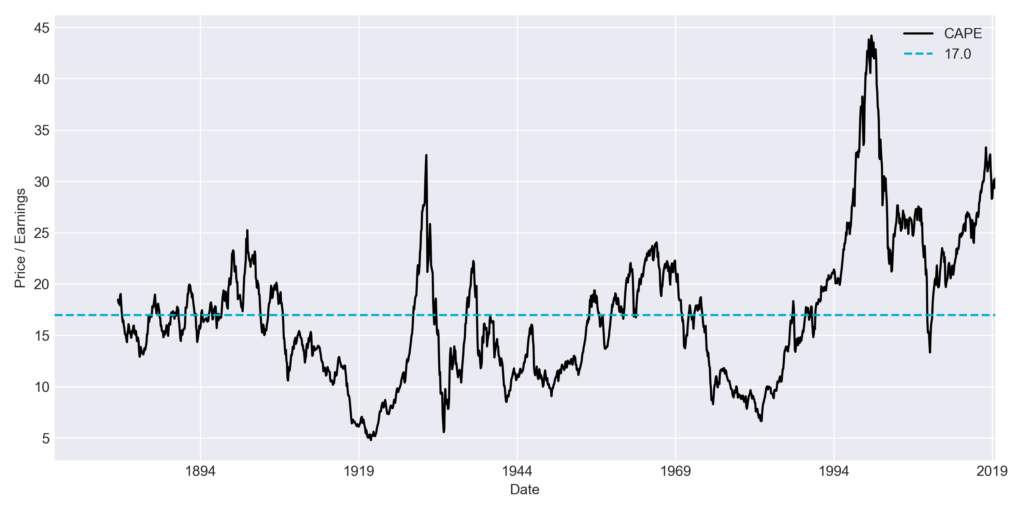
The chart below shows the Shiller PE ratio, which is the ratio of prices to average earnings in the last 10 years for companies in the S&P 500 index. This metric has been widely touted as evidence for why valuations are at worryingly high levels, with current low interest rates forming the major defence of why such high valuations can be sustained.

Figure 1: The Shiller Cyclically Adjusted PE ratio.
Figure 1: The Shiller Cyclically Adjusted PE ratio. Data courtesy of Robert Shiller [1]

Our own analysis suggests that valuations have become even more stretched for the most expensive stocks. To rank as one of the ten percent of most expensive US companies it currently requires a price earnings ratio above 60. At no point during our 60-year study, including during the dot-com boom, was this higher. It follows that many market participants are willing to pay a hefty premium for high quality or high revenue “growth” companies, in the belief that future profits will give them “jam tomorrow”. This bears some resemblance to the so-called Nifty-Fifty stock market boom of the late 1960s and early 1970s, where a bubble emerged amongst a small and concentrated group of large companies.

The narratives used to justify current high valuations both generally and with respect to high growth and high-quality companies have hallmarks of “this time it is different” about them. The risk to asset owners is that the world cannot sustain a low-interest rate, low-inflation and high profit growth environment, and that something must “give”. Furthermore, the Nifty-Fifty stock market boom provides some cautionary lessons on the risk of investors’ believing that valuations cease to matter for the “best” companies.

In the short-term the fund’s performance will be impacted by the sentiment of others in the markets, but in the longer term we believe that it will be driven by the performance of the businesses that we choose to buy. Our twin lines of defence against the current risks we see is to continue to hold some dry-powder, and only own stakes in sound businesses where undue optimism is not required to justify their purchase price. With hindsight an all-out bet on high-growth companies would have been more profitable than our own cautious stance so far in 2019, but our resolve to maintain our approach is, nonetheless, unchanged.

We believe that the current high tide is unlikely to never recede, but we cannot predict when it might turn or how far out it might travel. We move forward into the remainder of the year in the belief that our investment approach will leave our ship well placed to weather future storms.

Footnotes

[1] Data courtesy of Prof Robert Shiller (http://www.econ.yale.edu/~shiller)

Important information

Please ensure you have read this important information. The value of investments in WS Havelock Global Select may fall as well as rise. Investors may not get back the amount they originally invested. Investments will also be affected by currency fluctuations if made from a currency other than the fund’s base currency. Past performance is not a reliable indicator of future results. Potential investors should not use this website as the basis of an investment decision. Decisions to invest in WS Havelock Global Select should be informed only by the fund’s Key Investor Information Document (KIID) and prospectus. Potential investors should carefully consider the risks described in those documents and, if required, consult a financial adviser before deciding to invest. WS Havelock Global Select can invest more than 35% of its value in securities issued or guaranteed by an EEA state listed in the prospectus. The KIID and prospectus are available in English from this website and from Link Fund Solutions.

This website is not intended for any person in the United States. None of Havelock London’s services or related funds is registered under the US Investment Company Act of 1940 or the US Securities Act of 1933. This material is not an offer to sell or solicitation of offers to buy securities or investment services to or from any US person.

Filed Under: Commentary

May 22, 2019 By Matthew Beddall

What’s inside your pie?

As professional investors, managing the risk of losing money is a responsibility we take very seriously. The traditional approach when managing a portfolio is to allocate money to different opportunities as if it were a pie being sliced, with each slice being measured by the amount of money invested. Limiting how big a slice of pie you eat is a good way of managing the risk of over-eating, but when it comes to investing, judging risk based on the size of an investment works less well.

The same amount of money invested in two different companies does not result in the same risk of loss. For example, the amount of debt a company uses will alter the chances of it exposing investors to future losses. It is for this reason that we spend time looking inside the pie (company!) to understand the threats to a company’s on-going health.

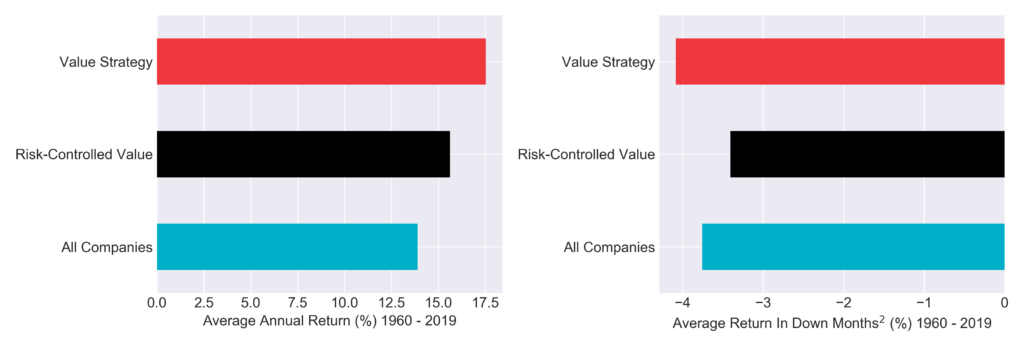
Our investment approach does not require us to be fully invested in stocks at all times, and the analysis below demonstrates how this helps us manage risk. We show the performance of a naïve value strategy, which each year selected the cheapest 10% of US companies based on their price/earnings ratio. This is compared to the performance of having invested equally in all US companies[1]. These results support the established academic result that a valuation-driven strategy can deliver superior long-term returns. As a simple measure of risk, we show the average return in down months[2], and on this basis the simple value strategy exposed investors to a greater risk of short-term loss than investing in all companies.

The value strategy also had long periods of time when it was subject to above-average levels of volatility as measured with the “beta” statistic (which quantifies the volatility of a stock, or group of stocks, relative to the average).  If we relax the need to invest entirely in stocks, we can attempt to make this risk more consistent through time. The “risk-controlled value” series in the charts takes the simple value strategy and attempts to control its relative volatility (or beta) to be 90% of the average. It did this by varying its allocation to the “value” stocks and investing the spare cash in US government bills. This combined approach of a value strategy coupled with risk control delivered simulated returns that were above average, whilst reducing the typical monthly losses.

This exercise is just an illustration and does not represent the actual way in which we select and weight companies in our portfolio. Instead, we wish to demonstrate that forcing yourself to be fully-invested in equities is like tying one hand behind your back when it comes to managing the risk of financial loss. It means that your risk of losing money is entirely determined by your choice of stocks, without any other way to make this risk stable through time. Being able to hold some money in the safe harbour of government debt can provide greater freedom to actively control this risk, whilst seeking the best long-term investment opportunities.

Using this flexibility to pursue more consistent risk management is part of our creed of “modern investment management”.


[1] Datasets are courtesy of Kenneth French and details of calculation methodologies are available on his website.

[2] We define down months as being those months where our all-companies portfolio experienced a loss.

Filed Under: Commentary

January 18, 2019 By Matthew Beddall

January Sales

Who doesn’t love a sale bargain? If you are like me, knowledge that you paid less than others, is enough to leave you feeling quietly smug about a new purchase, irrespective of if you really needed it! Why then all the upset when the stock market decides to hold a sale?

The opportunity to buy a share of a business at a knock down price should be welcomed by investors, but any feeling of joy is normally overwhelmed by the sense of regret at having not sold what you already own. Any would-be bargain hunter can relate to this, when you discover that your beloved recent purchase is suddenly available for even less than you paid. For most of us it is unrealistic to think that we can have the foresight to accurately “time the market”, but we still succumb to the emotion of regret when stock prices fall.

Four months have now passed since the LF Havelock Global Select fund launched. It was not lost on us that this followed a long period of rising stock prices, with the valuations of many companies resting on brave assumptions for their continued growth. Whilst we do not attempt to time markets, we only invest at prices that do not require undue optimism about a company’s future. A bull market makes bargains harder to come by, but this optimism is never unilateral. With 55,000-or-so publicly listed companies would be shoppers have plenty of choice.

Since October the stock market has been holding an extended end of year sale, based on growing pessimism about the prospects of many companies. In this time the fund held some “dry powder” outside of the stock market, which together with a valuation driven approach, provided us with much comfort. Moving into 2019 the pessimism that has descended on markets gives would-be bargain hunters more choice at their disposal.

Our approach is to estimate what we think a company is worth, by using data about its underlying business. We want to understand how it generates its profits and then use our experience in forecasting to estimate what the future might reasonably hold. These forecasts consider a range of future outcomes, some of which are optimistic and some of which are pessimistic. A scientific approach helps us quantify the likelihood of such events and guard against our judgements being clouded by emotion. Furthermore, using data to understand uncertainty helps us look beyond the short-term. We go into 2019 excited by the opportunity that uncertainty in markets creates for our approach, and wish you a happy, and bargain filled, New Year!

Important information

Please ensure you have read this important information. The value of investments in WS Havelock Global Select may fall as well as rise. Investors may not get back the amount they originally invested. Investments will also be affected by currency fluctuations if made from a currency other than the fund’s base currency. Past performance is not a reliable indicator of future results. Potential investors should not use this website as the basis of an investment decision. Decisions to invest in WS Havelock Global Select should be informed only by the fund’s Key Investor Information Document (KIID) and prospectus. Potential investors should carefully consider the risks described in those documents and, if required, consult a financial adviser before deciding to invest. WS Havelock Global Select can invest more than 35% of its value in securities issued or guaranteed by an EEA state listed in the prospectus. The KIID and prospectus are available in English from this website and from Link Fund Solutions.

This website is not intended for any person in the United States. None of Havelock London’s services or related funds is registered under the US Investment Company Act of 1940 or the US Securities Act of 1933. This material is not an offer to sell or solicitation of offers to buy securities or investment services to or from any US person.

Filed Under: Commentary

October 11, 2018 By Matthew Beddall

Rising wealth and market health

Like many investors, we worry about current equity market valuations looking historically high. Surely markets cannot continue to defy gravity? Although we believe that they are ultimately anchored to fundamentals, it pays to remember that we live in wealthy times.

This chart shows the wealth of the United Kingdom, expressed as a multiple of the country’s national income. Wealth in the UK, and elsewhere, has grown substantially since the end of the second world war, and the financial crisis of 2008 did little to slow this down.

Following the financial crisis, it is not only the stock market that has risen, but so too has a populist political movement. Arguably the rise of Trump and the Brexit vote are the product of discontent over how wealth is shared within society. Cuts in public spending and low wage growth, coupled with rising asset prices, have clearly served to increase the divide between the haves and have-nots. It is not our place to take a view on the correct divide of wealth within a society, but we recognise that the debate forms one of the major components of the economic climate that we operate within.

Has this growth in wealth, coupled with low interest rates, created increased demand for owning stocks? Does this mean that markets are not heading for an imminent fall? Or has the bull-market seen valuations become too high? Are investors not fully recognising the realities of the current political climate?

Our approach to investing is to not rely on any one narrative being correct. We attempt to understand the intrinsic value of an investment in a range of different scenarios in the belief that this will help us be robust to an uncertain future. We want to be part owners of companies that are not highly leveraged, purchased at prices that do not require undue optimism about the future. Furthermore, our preference is to currently hold some “dry powder” outside of the stock market. This forms the major part of our “proceed with caution” approach to the place in which we find ourselves as investors.

Filed Under: Commentary

September 5, 2018 By Matthew Beddall

A 584-million-mile journey

A full year has now passed since Havelock London was founded.

My reason for embarking on this journey was based on a vision of the future of investment management. This vision is based on two beliefs: firstly that technology will increase efficiency and lower costs for customers; and secondly that the growing abundance of data can be harnessed to quantify the uncertainties investors face and make more informed decisions.

The team at Havelock London have been putting this vision into practice and I am proud to announce that we have started deploying founder capital into a fund that operates according to our vision: LF Havelock Global Select. The investment decisions we make are grounded in data, using a combination of human and machine to give a transparent and disciplined process. The total charges (which include the ongoing charges) the fund will pay is capped at 0.99% and this includes portfolio transaction costs. The fund invests on a global basis in company shares and fixed income securities (government and corporate bonds) without using leverage or shorting. The fund’s Key Investor Information Document (KIID) and prospectus are available in English from Link Fund Solutions or from Havelock London on request.

Our focus is on finding decent companies where undue optimism is not required for us to think they represent good value.

Matthew Beddall, CEO, Havelock London

The fact that the fund launched the day before the S&P 500 marked its “record for the longest ever bull run” is not lost on me. Does this mean I am bullish on the equity market? Or might it be over-valued and ready for a correction?

We use data to estimate what companies are worth, under a range of scenarios, which allows us to decide if we think their share price represents good value. I believe this to be a more reliable form of decision making than prophecy, and with around 50,000 listed public companies this approach fortunately only requires us to hold an opinion about a tiny fraction of them.

On average valuations are historically high, which makes it more difficult to find businesses that we think make for attractive investments. Indeed, there are some companies where I believe market prices are based on considerable optimism about their future profits. This optimism may prove to be well-founded, but it contains within it a risk of disappointment. Cost cutting exercises, low borrowing costs and reduced corporate tax rates have all helped to increase company profits in recent history but are not repeatable indefinitely.

Our focus is on finding decent companies where undue optimism is not required for us to think they represent good value. These views are formed by an analysis of a custom set of data selected to be relevant to each individual business. . Our use of data then continues to help us decide the weight we place on each investment, to monitor our assumptions and to keep an eye on how each business evolves. All of this makes for a process where decisions are driven by facts and not speculation.

On what basis do I claim we have travelled 584 million miles? It is the distance that the earth has travelled around the sun in the last year, and our approach to investing requires our feet to be firmly on the ground! I would like to thank all our supporters and encourage you to keep following as we continue our epic journey.

— Matthew

Important information

Please ensure you have read this important information. The value of investments in WS Havelock Global Select may fall as well as rise. Investors may not get back the amount they originally invested. Investments will also be affected by currency fluctuations if made from a currency other than the fund’s base currency. Past performance is not a reliable indicator of future results. Potential investors should not use this website as the basis of an investment decision. Decisions to invest in WS Havelock Global Select should be informed only by the fund’s Key Investor Information Document (KIID) and prospectus. Potential investors should carefully consider the risks described in those documents and, if required, consult a financial adviser before deciding to invest. WS Havelock Global Select can invest more than 35% of its value in securities issued or guaranteed by an EEA state listed in the prospectus. The KIID and prospectus are available in English from this website and from Link Fund Solutions.

This website is not intended for any person in the United States. None of Havelock London’s services or related funds is registered under the US Investment Company Act of 1940 or the US Securities Act of 1933. This material is not an offer to sell or solicitation of offers to buy securities or investment services to or from any US person.

Filed Under: Commentary

  • « Go to Previous Page
  • Page 1
  • Interim pages omitted …
  • Page 6
  • Page 7
  • Page 8
  • Page 9
  • Go to Next Page »

Footer

The value of investments may fall as well as rise. Investors may not get back the amount originally invested. Past performance is not a reliable indicator of future results.

Important information | Privacy policy
Best Execution policy | Complaints policy summary | Remuneration policy summary | Responsible Investment policy | Stewardship code
Havelock London Ltd is authorised and regulated by the Financial Conduct Authority (FCA reference number: 799920). The company is registered in England & Wales at 19 Eastbourne Terrace, London W2 6LG (registered number: 10874884).

Copyright © 2026 All Rights Reserved